
Math Untangled

Sunday, October 18, 2015

Thursday, April 9, 2015
Saranac Lake Math Count™ Video Makes it to Final Four
 |
| Click here to view the Algebra Basketball video |
The video first went through a public vote and stayed within the top 100 videos. The second round was provided by judges that now advanced the team to the semi finals. The final voting will take place in Boston during the MathCounts™
The MathCounts team will present their video in Boston during the National Competition in May.
Sunday, July 27, 2014
Calculator fun
Calculator
fun.
Calculators are no substitution for knowing your facts, but
sometimes they can be used to make some fun mathematical discoveries.
For grades 1-3
Try multiplying any number by 10. What do you notice? Now try multiplying by 100. Now 1000.
Think you could do it without a calculator now?
Grades 4-5
Same as the younger kids, try multiplying any number by 10
then 100 then 1000. Seems pretty simple
doesn’t it. You might not need a
calculator. Before you make up a rule
though, try multiplying a number like 4.7 by 10, then 100 then 1000. Now try 2.587.
Once you feel that you can come up with a rule, try dividing
by 10, then 100, then 1000. Can you
figure a rule out for that?
Grades 6-8
Alright, get out you calculator but also paper and
pencil. I’ve got two tricks you might
find pretty cool.
Start with a two digit number, like 35 and multiply it by
11. When you get the answer write it
down making the middle number a different color. Try this several times. You should start to see a neat pattern
forming making it easy to multiply any two digit number by 11 without a
calculator.
Now check this out.
Take any two digit number ending in 5, like 45. Square it (multiply it by itself.) Write down your answer. Do this again several times. What do you notice? It might take a little while and you may need
to ask your parents for some help, but a real nice pattern is there.
Monday, July 21, 2014
Math Circle Fun
Circle Fun
Grades 1-3
You'll need a ruler for this. Near the center of a piece of paper make a dot. Now, measure a distance in any direction from that dot and make another dot. Do this again measuring the same distance from the original dot now in a different direction. Keep going back to the same dot and measuring the same distance only in different directions. When you've done this many times, say at least 10, connect the outer dots. What if you did this a million times? What do you think it would form?
Grades 4- 5
Cut a regular piece of paper into strips 3 inches wide. Roll them up to make 3-inch long tubes less than 2 inches in diameter. Now, using another piece of paper, Using either a compass or simply a piece of string, make a circle with radius 1 inch, then 2 inches, then 3 inches and so on. Cut the circles out to form disks. Between each disk place a tube and see how high you can build a tower.
Grades 6-8
Using a sewing tape measure, find a something circular in the house. Measure the distance around the circle. Now measure the distance across at its widest point (diameter.) Next take the distance around (this is the circumference) and divide by the diameter. Record your answer. Repeat with other circular objects recording your answer each time. Do you notice something happening? Anything familiar?
Grades 1-3
You'll need a ruler for this. Near the center of a piece of paper make a dot. Now, measure a distance in any direction from that dot and make another dot. Do this again measuring the same distance from the original dot now in a different direction. Keep going back to the same dot and measuring the same distance only in different directions. When you've done this many times, say at least 10, connect the outer dots. What if you did this a million times? What do you think it would form?
Grades 4- 5
Cut a regular piece of paper into strips 3 inches wide. Roll them up to make 3-inch long tubes less than 2 inches in diameter. Now, using another piece of paper, Using either a compass or simply a piece of string, make a circle with radius 1 inch, then 2 inches, then 3 inches and so on. Cut the circles out to form disks. Between each disk place a tube and see how high you can build a tower.
Grades 6-8
Using a sewing tape measure, find a something circular in the house. Measure the distance around the circle. Now measure the distance across at its widest point (diameter.) Next take the distance around (this is the circumference) and divide by the diameter. Record your answer. Repeat with other circular objects recording your answer each time. Do you notice something happening? Anything familiar?
Sunday, July 13, 2014
Junk Mail and Mail?
Grades 1-3
Count how many pieces of junk mail make it to the recycling
bin each day. Compare the number of
pieces of junk mail to other mail. Make
a big comparison at the end of the week.
Grades 4-5
Junk mail can be pretty heavy. Keep track of the junk mail that ends up in
the recycle bin in your house. At the
end of the week, hold it all while you stand on a bathroom scale. Then weigh yourself and subtract. This is how much weight your family recycled
in junk mail this week. Multiply by 52
and you’ll have an idea of how much junk mail comes to your house every
year.
Grades 6-8
Does one day of the week generate more junk mail than the
others? Try setting up a simple line graph
for a couple of weeks. Record the number
of pieces that your family receives each day.
Make a prediction for the third week and see what happens.
Sunday, July 6, 2014
Measuring up
Grades 1-3
Take a sewing tape measure outside and into the woods. A fairly loose way to determine the age of a
tree without cutting it down and counting rings is to measure the circumference
(distance around.) A tree’s age in years
is approximately the same as its circumference in inches.
Grades 4-5
Find a can of paint in your house. Read the label to see how much area can be
covered with one can. Using a tape
measure find a part of your house that could be covered by one can of the
paint. Kids, this is a math
question. Please don’t see how much the
can will cover by actually painting!
The same could be done with grass seed. How many bags you will need to seed your
whole back yard?
Grades 6-8
Ruler Guestimation – Just like guessing a number between 1
and 100 only you are trying to find a number between 1 and 12 on a ruler. These numbers, however, include all the
fractional parts of an inch. For
example,
The number to find is 6 9/16
Guess: 6
Response: higher
Guess : 7
Response: lower
Guess: 6 ½
Response: higher
Guess: 6 3/8
And so on.
Monday, June 30, 2014
Rolling the Dice

Rolling the Dice
Materials Needed:
Grades 1-3: 2-3 dice
Grades 4-5: 2-3 dice
Grades 6-8: 4 dice
Grades 1-3
The basic starting point for using dice for learning and reviewing math facts is to have the child roll two dice and add them together. Have the child keep track of each score. Whoever reaches 500 first wins.
If your child has advanced beyond that point, make it more challenging by using three dice. Roll the first die for a target number. Then roll the other two dice until together they add up to the target number of the first die. Add all the various rolls together and the person that has a total of 500 first, wins!
Grade 4-5
The basic starting point for using dice for children in Grades 4-5, is to roll two dice and have the child multiply them together. If you child is more advanced, have the child roll two dice and add them together and then repeat. Then multiple the two sums. Keep track of each score and the first person to reach 500 first, wins!
Grades 6-8
24 Game
Roll four dice. Take the four numbers you rolled and use them to make 24. You can only use the four numbers, but you can use them in any way. For example:
You roll 6 , 9 , 3 , 2.
6 + 9 + 32 = 24
You roll 1 , 4 , 9 , 2
2(9 + 4 – 1) = 24
Sunday, June 1, 2014
Math Quotes
"I believe that if you show people the problems and you show them the solutions they will be moved to act."
~ Bill Gates
Thursday, May 1, 2014
Grade 3-8: Art in Math - Origami

Extreme origami
Erik and Mark Demaine win the Guggenheim award for their curved-crease sculptures. The Demaines used origami to be a powerful tool to study mathematics, the father-and-son duo explore foldable forms from both mathematical and artistic perspectives. This concentric circle shape can be traced back to the Bauhaus, which the Demaines have extended further by pushing multiple concentric circles together.
Their mathematical origami was on view through January 2014 at the Museum of Modern Art’s Applied Design collection.

Tuesday, April 1, 2014
Grade 6-8: Art in Math - Geometry in Art

Hyperbolic lampshade by Gabriele Meyer
In the April 2014 issue of Discover Magazine the bridge between art and mathematics is explored where artists use equations and geometry to create beautiful works of art.
Visions of Math
 The Bridges Organization, oversees the annual Bridges conference on connections between art and mathematics.
Bridges began in Kansas in 1998. Since then it has traveled to cities in North America and Europe, and has attracted participants from over thirty countries. The conference features invited speakers, full and short paper presentations, educational workshops, a juried art exhibition, a mathematical poetry reading, and a short movie festival.
Friday, March 14, 2014

Saturday, February 1, 2014
Grade 1-8: Contest - Doodle 4 Google
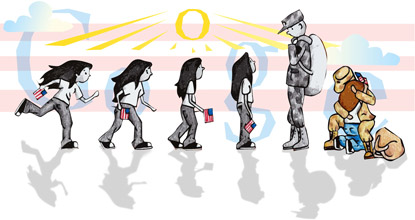
Create your doodle in a new document 1894 pixels high by 2960 pixels wide at 300 dpi. Eligible Doodles must be two-dimensional and scannable.
The contest takes place between February and March each year. There is an opportunity for the public to vote through April and then judges view entries from all 50 states with winners announced each June.
To inspire the creative process:
There are also various fun activities set up in partnership with Discovery Education, are designed to help K-12 classrooms (and individuals) stretch their creative muscles and warm up for the Doodle 4 Google competition.
Thomas Edison once said, “To have a great idea is to have a lot of them.”
Activities for Grades K-2
Activities for Grades 3-5
Activities for Grades 6-8
Activities for Grades 9-12
Wednesday, January 1, 2014
Grades: 6-8: Art in Math- Making Art Using Equations Autologlyph
According to Discover magazine many artists use calculations and numerical analyses as a rich source of ideas and methods for their creations.

This is a self-referential bunny — a sculpture of a bunny, the surface of which is tiled by 72 copies of the word "Bunny."
This piece is part of a larger series of "autologlyphs," following on from HS's "Sphere Autologlyph" from the 2010 Bridges art exhibition. An autologlyph is a word written or represented in a way which is described by the word itself. This style of autologlyph combines Escher-style tessellation with typographical ideas related to ambigrams.
Sunday, December 1, 2013

Friday, November 1, 2013
Grade 1-3: Addition or Subtraction Jump Rope (Skipping)

Materials Needed:
Jump rope
flash cards (optional)
Two people: one to skip rope and the other to call out the equation
This activity enables students to practice addition and subtraction by creating simple math equations.
Person 1: Will create a math equation and say it out loud without stating the answer. For example 1+1=
Person 2: Will skip the answer by repeating the equation and then solving the problem. For example 1+1=2.
The same can be done for subtraction, but instead have the Person 2 (skipping) jump backwards during the subtraction.
Person 1: 2-1=
Person 2: Skips twice forward, stops, skips one back. 2-1=1
Tuesday, October 1, 2013
Grade 6-8: The Fibonacci's Sequence

The simplest is the series 1, 1, 2, 3, 5, 8, etc. The next number is found by adding up the two numbers before it.
- The 2 is determined by adding the two numbers before it (1+1)
- Similarly, the 3 is determined by adding the two numbers before it (1+2),
- And the 5 is (2+3),
- and so on!
(The Fibonacci sequence is defined by the property that each number in the sequence is the sum of the previous two numbers; to get started, the first two numbers must be specified, and these are usually taken to be 1 and 1. In mathematical notation, if the sequence is writtenthen the defining relationship is

with starting conditions  .)
.)
.)Sunday, September 1, 2013
Grade 3-8: Converting to the Metric System

Did you know?
• The Metric System is official known as Le Système International d'Unités, or the International System of Units, it's more simply known the world over by its abbreviated name, the SI.
• In the 1790s and during the Revolution in France that the French devised the primitive basis for the modern metric base-10 system.
• The meter was originally 1/10,000,000 the distance from the North Pole to the Equator, through Paris Francel.
• a gram is the weight of one cubic centimeter of water, which makes 1 liter of water weighs 1 kilogram
• metric units are all all multiples of ten
• More than one type of ton? Yes!
A short ton is equal to 2,000 pounds or about 907 kilograms.
A long ton is equal to 2,240 pounds, or about 1,016 kilograms.
A metric ton, which is assigned the official symbol "t" in the International System of Units, is equal to 1,000 kilograms, or about 2,204 pounds which is also 1 megagram -- denoted by the symbol Mg.
The Metric System is Case Sensitive: What?
mm = milimeter
Mm= megameter
The basic metric units are:
meters (for length)
grams (for mass or weight)
liters (for volume)
The different units convert into one another:
one milliliter = one cubic centimeter
one gram = the weight of one cc of water.
Thursday, August 1, 2013
Grade 3-5: Cooking with Math

Below is a simple recipe to make Rice Krispies squares. Choose a different recipe and let you child explore various measurements. Double the recipe and have the child calculate the new measurements.
Most of all, Have fun!
Recipe: Kellogg's Rice Krispies Treats (12 servings)
INGREDIENTS
3 tablespoons butter
1 package (10 oz., about 40) marshmallows
or 4 cups JET-PUFFED Miniature Marshmallows
6 cups Kellogg's® Rice Krispies® cereal
DIRECTIONS
1. In large saucepan melt butter over low heat. Add marshmallows and stir until completely melted. Remove from heat. 2. Add KELLOGG'S RICE KRISPIES cereal. Stir until well coated.
3. Using buttered spatula or wax paper evenly press mixture into 13 x 9 x 2-inch pan coated with cooking spray. Cool. Cut into 2-inch squares. Best if served the same day.
MICROWAVE DIRECTIONS:
In microwave-safe bowl heat butter and marshmallows on HIGH for 3 minutes, stirring after 2 minutes. Stir until smooth. Follow steps 2 and 3 above. Microwave cooking times may vary.
3. Using buttered spatula or wax paper evenly press mixture into 13 x 9 x 2-inch pan coated with cooking spray. Cool. Cut into 2-inch squares. Best if served the same day.
MICROWAVE DIRECTIONS:
In microwave-safe bowl heat butter and marshmallows on HIGH for 3 minutes, stirring after 2 minutes. Stir until smooth. Follow steps 2 and 3 above. Microwave cooking times may vary.
The ratio of ingredients is important because if you put in too much or one ingredient and not enough of another, the finished product will not be consistent and most likely won't taste good.
Monday, July 1, 2013
Math Games: Fractals
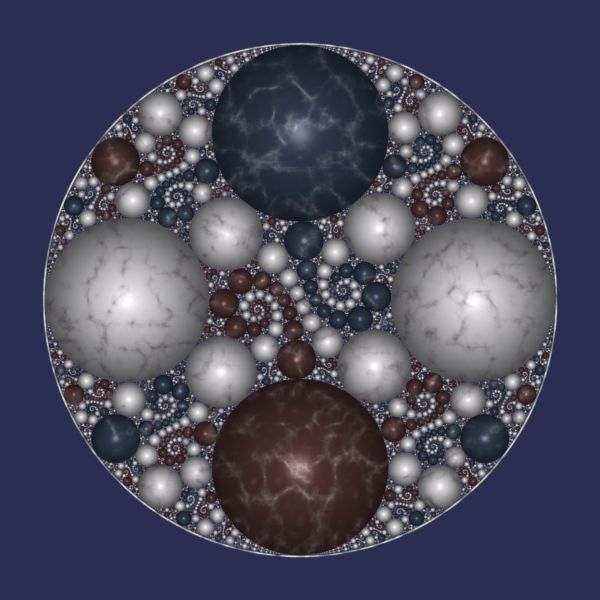 According to Merriam Webster, a fractal is a curve or geometric figure, each part of which has the same statistical character as the whole. Fractals are useful in modeling structures (such as eroded coastlines or snowflakes) in which similar patterns recur at progressively smaller scales, and in describing partly random or chaotic phenomena such as crystal growth, fluid turbulence, and galaxy formation.
In 1979, while studying the Julia set, Mandelbrot discovered what is now called the Mandelbrot set and inspired a generation of mathematicians and computer programmers in the study of fractals and fractal geometry.
Fractals involve numbers and equations, like other mathematician ideas. The difference is that fractals can be used to generate complex, beautiful images.
Here is a gallery of computer-generated fractals.
Saturday, June 1, 2013
Math Games: Elementary Math Scavenger Hunt
 |
| © Diane Chase, www.AdirondackFamilyTime.com |
Counting:
Can your child find 1 leaf, 2 dandelions, 3 flowering trees, 4 birds, and 5 pebbles?
How many flowers does he or she see?
What other things is your child observing?
Pick a bouquet of flowers and count how many flowers of each color, add them together.
How many petals are on a particular flower?
Subscribe to:
Posts (Atom)